

TRIM Performance:
While SSDs offer many benefits, there are some downsides to using flash memory. One of the biggest issues people run into is performance degradation. Over time, an SSD will run out of fresh blocks and will have to write over data the file system has marked as deleted. This procedure is very complicated and can slow an SSD's write speeds considerably.
To address this problem, most manufacturers have added TRIM support to their SSDs. The TRIM command allows an operating system, such as Windows 7, to tell an SSD which data blocks are no longer in use. Using this information, the drive proactively erases these blocks and adds them to the free block pool.
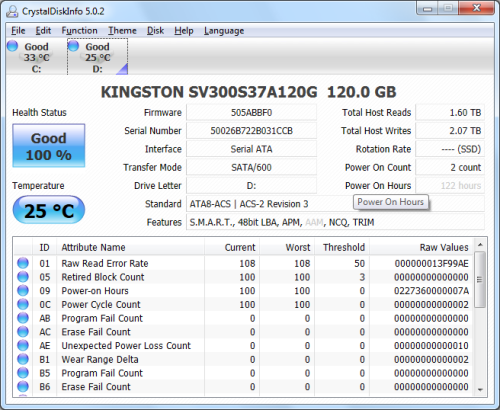
I should point out that the SSDNow V300 ships with SandForce's 5.0.5 firmware. Earlier releases of the Series 5 firmware had problems with TRIM, which are fixed in this version.
To test the V300's TRIM function, I first put the drive in a "dirty" state. I used Iometer to fill the entire drive and then ran a random write test for 20 minutes. Looking at the screenshot below, you can see that the V300's average read and write speeds dropped to 126.9 MB/s and 198.4 MB/s, respectively.
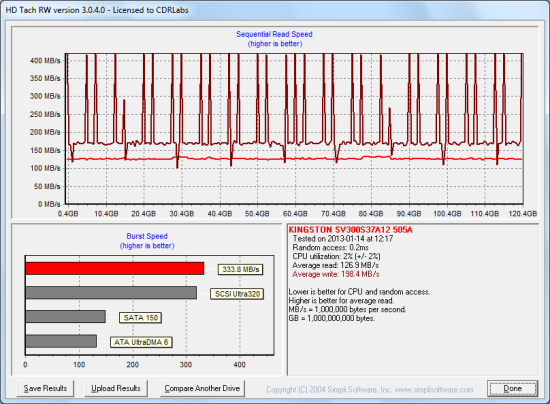
Kingston SSDNow V300 120GB - Dirty
To see how well the V300 could recover, I let the computer sit for a few hours and then reran the test. The drive's average read speed jumped back up to 307.6 MB/s. However, its write speed lagged a bit behind, averaging out at 211.6 MB/s.
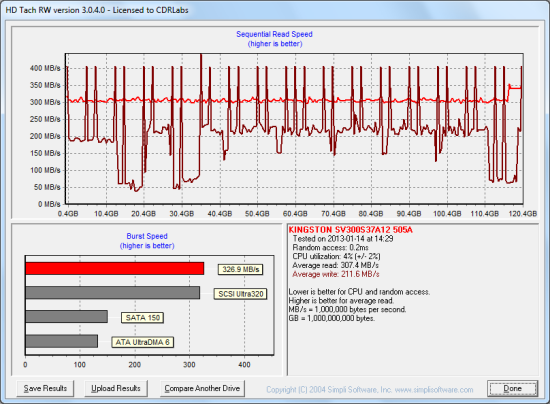
Kingston SSDNow V300 120GB - After Trim
Lastly, I used an older version of OCZ's Toolbox utility (yes, it works) to perform a secure erase on the V300. With the drive wiped clean, its average write speed jumped back up to 385.8 MB/s.
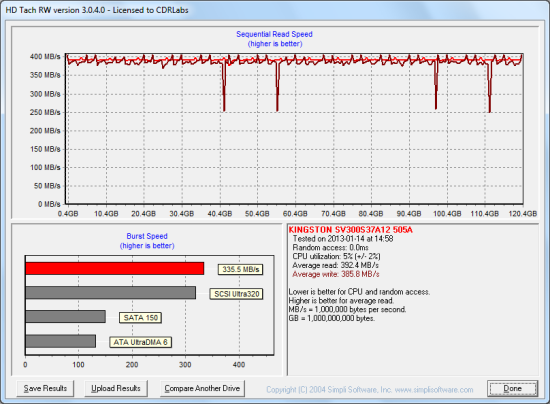
Kingston SSDNow V300 120GB - Secure Erased
Final Thoughts:
The Kingston SSDNow V300 is an excellent choice for the cost-conscious consumer looking to upgrade their existing desktop or notebook PC. This new solid state drive combines LSI's SandForce SF-2281 controller with Toshiba's 19nm MLC Toggle Mode NAND flash to deliver some surprisingly good performance. While rated at only 450 MB/s, the 120GB V300 was able to read at speeds as high as 585 MB/s and write at speeds in excess of 500 MB/s. It also exceeded expectations in our random write tests, delivering more than 80,000 IOPS at low queue depths. Impressive performance isn't the only thing the V300 has to offer either. Along with a good looking, well constructed design, the SSD is available as a standalone drive or as part of an upgrade kit containing cloning software and other accessories for a desktop and/or notebook system.
The SSDNow V300 is available in 60GB, 120GB and 240GB capacities. Prices on Amazon.com currently range from about $75 up to $242, with the 120GB desktop upgrade kit reviewed here going for about $120.

Highs:
- Available in 60GB, 120GB and 240GB capacities
- SandForce SF-2281 processor
- Toggle Mode NAND flash
- Excellent sequential read and write speeds
- SATA 6Gb/s interface
- Supports SMART, TRIM and Garbage Collection
- Available as stand-alone drive or as part of an upgrade kit
- Well constructed design
- Ultra-slim form factor
- Reasonably priced
- 3 year warranty
Lows:
- Not as fast when writing incompressible data


